Should I Advertise on Facebook, Google, or Both?
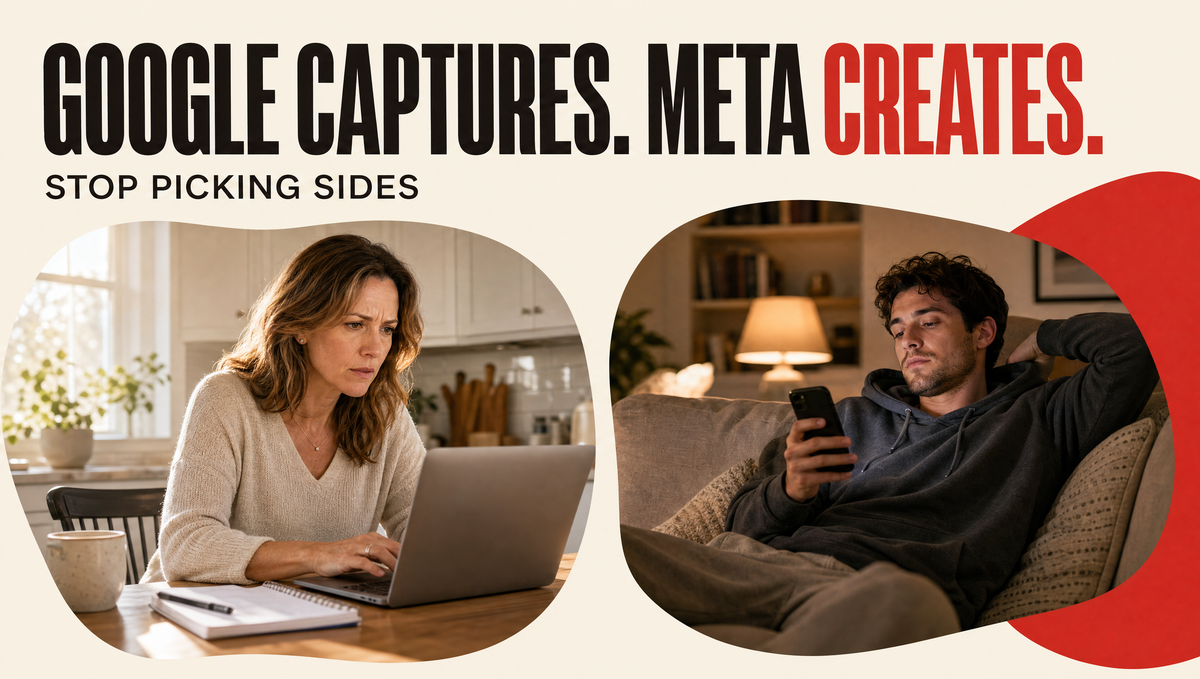
This gets framed as a rivalry, which is the wrong frame entirely. Google and Meta are not competing products — they do fundamentally different jobs. Asking which is better is like asking whether a fishing net beats a fishing rod.
The useful question is narrower: given your product, your margin and your budget, which job needs doing first?
Key Takeaways
- Google captures demand that already exists. Meta creates demand that doesn't. If nobody searches for your category, Google cannot help you regardless of budget.
- Google Ads search CPC averaged $2.96 in Q1 2026, up from $2.64 a year earlier. Meta traffic campaigns average roughly $0.70 CPC.
- Google's higher click cost buys pre-qualified intent; Meta's cheaper reach requires you to supply the persuasion through creative.
- Running both properly requires roughly double the minimum viable budget. Below about $5,000 a month, pick one and fund it properly.
- Meta spend generates branded Google searches, so measuring the two channels in isolation systematically undercredits social and overcredits search.
What's the short answer?
If people already search for what you sell, start with Google. If they don't, start with Meta. Run both once your budget can fund each above its minimum viable spend — roughly $5,000 a month combined for most businesses.
The reason so many advertisers get this wrong is that they choose based on where they personally spend time, or where a competitor advertises, rather than on whether demand for their product exists as a search query.
What is the fundamental difference between them?
Google is a demand-capture channel. Someone types "emergency plumber Manchester" and declares both a need and a timeframe. Your job is to be present and credible. Persuasion has already happened — the customer persuaded themselves before they opened the browser.
Meta is a demand-creation channel. Nobody opens Instagram intending to buy your product. Your ad interrupts something else. Your job is to create the want and then serve it in the same three seconds.
Everything else — the cost differences, the creative requirements, the timelines — follows from this distinction.
It also explains the most common failure in each. On Google, businesses fail by bidding on keywords with no commercial intent. On Meta, businesses fail by running ads that would work as Google ads — product features and a discount code, aimed at someone who has not yet been given a reason to care.
How do they compare on the numbers?
| Dimension | Google Ads (Search) | Meta (Facebook / Instagram) |
|---|---|---|
| Average CPC | $2.96 (Q1 2026), up from $2.64 in Q1 2025 | ~$0.70 for traffic campaigns |
| CPC range by industry | $1.63 (arts & entertainment) to $9.87 (legal) | $0.34 (shopping/gifts) to $1.22 (finance & insurance) |
| Average CTR | 3.52% search average, climbing three years running | Healthy range ~1.4–2.2% |
| Reported ROAS | Varies widely; inflated by branded search | Median ~1.93x across industries |
| Buyer intent | High — user declared the need | Low — user was doing something else |
| Primary performance lever | Keyword and landing page relevance | Creative |
| Creative demand | Low — text ads last months | High — fatigues in weeks |
| Scale ceiling | Capped by search volume | Effectively uncapped by audience size |
| Time to stable results | 2–4 weeks | 4–8 weeks |
| Works at low budget? | Yes — intent substitutes for volume | Poorly — needs ~50 conversions/ad set/week |
The line most worth dwelling on is the last one. Google can work on a small budget because buyer intent does the targeting work that Meta's algorithm needs conversion volume to learn. A business spending $1,500 a month can run a focused, profitable search campaign on three high-intent keywords. The same $1,500 on Meta conversion campaigns will likely sit below the learning threshold indefinitely.
When does Google win?
- Urgent or problem-driven purchases. Emergency services, repairs, legal, medical, anything with a deadline attached.
- Established categories with real search volume. If a keyword tool shows meaningful monthly volume for your problem, that demand is already there to be bought.
- High order values. A $9.87 legal click is fine when a client is worth $5,000. Even the highest CPCs are cheap against a large contract value.
- Products that need explanation. A landing page has room to explain what an Instagram ad does not.
- Small budgets. As above — intent substitutes for algorithmic learning volume.
- Local service businesses. "Near me" searches carry high intent and often lower competition than national terms.
When does Meta win?
- Visually demonstrable products. If three seconds of video conveys the value, Meta's format is doing the selling for you.
- Discretionary and impulse purchases. Nobody searches for a candle subscription they had not thought of.
- New categories with no search volume. The only real option — you must create the demand before anyone can search for it.
- Low order values. A $40 product can absorb a $0.70 click but not a $3 one.
- Brands with creative capacity. Meta rewards volume and variety of creative more than any other lever.
- Businesses that need scale beyond search volume. Once you own your category's search demand, Meta is where additional growth comes from.
When should you run both?
Both channels make sense when three conditions hold at once:
- Your combined budget can fund each above its minimum viable spend — usually around $5,000 a month total, though the exact figure depends on your target CPA.
- You have creative capacity to sustain Meta, not just launch it.
- You have measurement that reconciles both to revenue, rather than summing two platform reports that each claim the same sales.
If any of those is missing, running both is worse than running one. You will produce two underfunded channels, two learning phases that never complete, and reporting that cannot tell you which is working.
The sequencing that works: fund one channel to profitability, fix your site conversion rate, then add the second. Adding a channel is a scaling decision, not a diversification instinct.
What is the hidden interaction between them?
This is the part most advertisers measure wrong, and it changes budget decisions.
Meta spend generates branded Google searches. Someone sees your Instagram ad, does not click, remembers you two days later, and googles your brand name. Google captures that conversion at a low cost per click with a high reported ROAS. Meta gets no credit at all — there was no click to attribute.
The consequences compound in a specific and expensive direction:
- Your branded search campaign looks like your best performer, because it is harvesting demand other channels created.
- Your Meta prospecting looks like your worst performer, because it created demand it never got credit for.
- Rational-looking optimisation — cut Meta, increase Google brand — cuts the channel generating the demand and increases the one merely collecting it.
- Three months later, branded search volume falls and nobody can explain why.
Two practical defences. First, watch your branded search volume as a dependent variable — if it rises when Meta spend rises, Meta is doing demand-creation work your attribution cannot see. Second, judge the pair on blended MER rather than channel ROAS. Total revenue divided by total ad spend does not care which platform claimed the sale.
Full measurement method in [how do I know if my advertising budget is being spent wisely].
How should you split budget between them?
Start from your demand type rather than a fixed ratio.
| Business type | Meta | Reasoning | |
|---|---|---|---|
| Local service (trades, clinics) | 70–80% | 20–30% | High-intent local search dominates; social supports awareness |
| B2B services | 60–70% | 30–40% | Problem-aware buyers search; social builds category familiarity |
| Established ecommerce | 40–50% | 50–60% | Shopping and brand capture demand; social drives new discovery |
| DTC / new category | 20–30% | 70–80% | Little search volume exists yet; demand must be created |
| High-ticket considered purchase | 60% | 40% | Long research cycles favour search; social sustains presence |
Treat these as starting positions, then let data move them. The reallocation rule that works: shift budget toward whichever channel is producing customers below your allowable CAC, and away from whichever is above it — measured blended, not by platform report.
Frequently Asked Questions
Which is cheaper, Facebook or Google ads?
Meta is cheaper per click — roughly $0.70 against Google's $2.96 average in Q1 2026. Cost per customer is a different question, and often favours Google, because search traffic converts at a much higher rate. Compare cost per acquisition, never cost per click.
Can I run both on $2,000 a month?
You can, but you probably shouldn't. Split across two platforms, each gets $1,000 — below Meta's learning threshold for most target CPAs. Put the full amount into whichever channel your demand type points to, get it profitable, then expand.
Is Facebook advertising dead?
No. Average CPC around $0.70 with median ROAS near 1.93x describes a functioning channel. What has changed is that targeting has been automated and creative now carries performance. Advertisers who have not adjusted to that experience the shift as decline.
Should I use Performance Max or standard search campaigns?
Standard search first, until you have enough conversion data to trust automation and enough visibility to interpret it. Performance Max blends inventory in ways that make diagnosis harder, and it tends to absorb branded search traffic while reporting it as new performance. Add it once you can measure clearly enough to catch that.
How long should I test a channel before deciding?
Ninety days at a budget above the channel's minimum viable spend. Shorter tests measure the learning phase rather than the channel. If you cannot fund 90 days above threshold, you cannot fairly test that channel — choose the other one.
The bottom line
Google and Meta are not alternatives. One harvests demand, the other creates it, and most businesses eventually need both — in that order, funded properly, measured together.
Start with whichever matches your demand type. Fund it above its learning floor for 90 days. Fix your conversion rate. Then add the second channel and measure the pair on blended efficiency, because the moment you run both, channel-level ROAS stops telling you the truth.
Sources
- DigitalApplied, "Google Ads Benchmarks 2026: CPC, CTR, CVR by Industry" — Q1 2026 average search CPC of $2.96, up from $2.64 in Q1 2025.
- Get-Ryze, "Google Ads Benchmarks 2026 — Avg CPC, CTR, CPA by Industry" — industry CPC range of $1.63 (arts & entertainment) to $9.87 (legal services).
- Web Tonic, "Google Ads Benchmarks 2026: CPC, CTR, CVR, CPL" — average search CTR climbing to 3.52%.
- Visible Factors, "Facebook Ads Benchmarks: Performance Analysis (2026)" — average Meta CPC of $0.70 for traffic campaigns, median ROAS ~1.93x.
- Hawky.ai, "Facebook Ads Benchmarks by Industry (2026 Data)" — lowest-CPC categories (shopping/gifts $0.34) and highest (finance & insurance $1.22).